Showing posts with label standardized tests. Show all posts

Tuesday, October 20, 2009

Absurdities

I went to a workshop yesterday on rules I should know and came back with three pages of notes and two pages of ideas about a research project. It was a nice drive too. Mrs Muffet (our GPS, who sits on a tuffet) took me back home by way of a mountainous stretch of I-40, which was more excitement than I needed without coffee or a nap to fortify me. I made some new acquaintances, which is always the highlight of such trips. Getting there was a trip in itself, logically. It went like this, in a series of emails to the organizer, who I'll call Mrs. K:
Me: Hi. Our copiers are being replaced, and I can't fax the form, so my information is enclosed.

Mrs. K: Okay, but I need the fax.

Me: Our machines are still wonky. I've scanned the completed form and attached it as pdf.

Mrs. K: Can you send me the fax?

Me: I was hoping you could just print the pdf...?

Me (day before the meeting): Hi. I haven't got confirmation yet. Am I on the list?

Mrs. K: If you send me the fax we can get you on today.
I sent the damned fax.

While I was driving I amused myself with a riff on a topic from an ASSESS post. Someone had asked about measuring the consequences of values and beliefs. The discussion was very useful I'm sure, but the use of 'measurement' in assessment makes me itch, and I imagined the following dialogue at an imaginary Lenin School of Management:
Stani: How did I do on my test?

Vlad: Ah...not good at all, I'm sorry to say.

Stani: What happened???

Vlad: You don't believe in the precept that the means justifies the ends.

Stani: Why would you think that?

Vlad: We measured your belief. Less than 10%: shameful.

Stani: But I do believe that the ends justifies the means.

Vlad: No, you don't. You believe that you believe it, but you don't actually believe it.

Stani: Your measurement shows that too?

Vlad: Verily.

Stani: And you believe these measurements?

Vlad: Of course. Here is my score--see: 100% belief in the measurements.

Stani: But what if the measurements are wrong?

Vlad: I don't believe the measurements are wrong. I showed you my score.

Stani: But if the scores are wrong, then the measurements don't mean anything,
regardless of what you believe.

Vlad: I don't believe that to be the case.

Stani: So if the scores told you that you believed in the tooth fairy, you would believe them, even if you don't believe in the tooth fairy?

Vlad: I can believe that I believe in the tooth fairy without believing in the tooth fairy. Just like you can believe that you believe that the ends justify the means, even if you don't really believe it.
This seems rather like a Monty Python script. On the other hand, there is a lot of believing in the scores. As evidence, I present iCritical Thinking(tm) test, which aims to solve this problem:
Today's academic and professional environments demand more than current Internet and computer skills. They also require students and employees to navigate, critically evaluate and make sense of the wealth of information available through digital technology.
In college, we call it information literacy. At least, this is pretty close, although it involves using office applications to negotiate "scenarios." This isn't ambitious enough to market, apparently, because the presentation on the website blurs the lines between nuts & bolts online skills and "critical thinking," whatever that is. The marketing material uses quotes like this one attributed to Pres. Obama (you can find the original here):
The solution to low test scores is not lower standards; it's tougher, clearer standards... I'm calling on our nation's governors and state education chiefs to develop standards and assessments [that measure] 21st century skills like problem-solving and critical thinking..."
Another one targets employers, and uses a quote from The Economist (Oct. 5, 2006):
The nature of the economy is changing. It's putting more and more premium upon intellectual skills, analytical skills, creative skills, which are in short supply.
The implication is that this company can certify that you have these valuable and complex skills. There's plenty more, including the usual claims of impeccable validity (for what isn't exactly addressed; see "Questions of Validity"). Saying a test is valid is like saying a tool is useful. Useful for what? Changing the oil filter or pounding nails? Or just weighing down that big stack of meeting minutes on your desk? The construction of the test material is likewise celebrated (here):
The development of the Global Standard 3 took over 9 months of research, data collection from 400+ subject matter experts from over 30 countries and final ratification from the members of the Global Digital Literacy Council. By going through this rigorous process it ensures that Global Standard 3 is not only current and relevant, but a true global digital literacy standard.
So this truly is a one-size fits all test, conveniently administered in an hour, that can be used from high school through career path, through the entire world of 6000+ spoken languages and innumerable cultures, to assess digital literacy (but we want you to think critical thinking).

This is of the same species as the "measuring belief" absurdity above, and represents an insidious problem. The song goes like this (to the tune of "Goodbye Yellow Brick Road"):
  1. There is increasing demand for certification of skills due to the diversity of educational experiences. See "Scaling Higher Ed" for more.

  2. There is also increasingly desperate and more insistent demands from the government(s) for "measurable standards."

  3. Beyond low-complexity skills, it is difficult or impossible to construct valid instruments that are very general in nature (i.e. amenable to standardized testing). For broad-spectrum skills like critical thinking, validity is a slippery concept.

  4. Apply Zog's Lemma--where error with economic value exists, it will be sold. Who better to do that than standardized test makers?

  5. Apply something like Gresham's Law: bad assessments drive out good assessments. This amplifies the largeness of the mistake by industrializing and institutionalizing tests and scores of dubious validity. It creates a monological definition of what "thinking" is, viz., "thinking" means a score on a standardized test. Think of the outsized value placed on SAT scores.
You can see all of these except the last one evidenced in the iCritical Thinking materials. There's little in the way of modesty about the claims. And who's to prove them wrong? Certainly, the business model is a good one: the next thing that comes along is "prep materials" for the test (see "Closing the Loop CLA-style"), and possibly end-to-end control of the curriculum, coaching, and test.

There are already plenty of information literacy programs and tests out there. TILT (now under re-development, apparently) is the one I've heard librarians mention the most. But it doesn't come with slick marketing materials that claim ultimate relevance.

I have to wonder what professional psychometricians think about all this. This industry is theirs, the unfortunate language of "measuring" mental traits is theirs too. There are serious attempts to come to grips with some of the fundamental problems, like Bennett and Hacker's Philosophical Foundations of Neuroscience. And there are plenty of academics in the field who work hard at validity and don't inflate claims. But where is the general hue and cry, the expert advice to lawmakers that, no, we don't really measure minds, and any standardized test is bandwidth-limited simply because it's standardized. I don't see it. Maybe someone can point me in the right direction.

(photo from this site)

Thursday, February 05, 2009

What's Wrong with Standardizing Minds

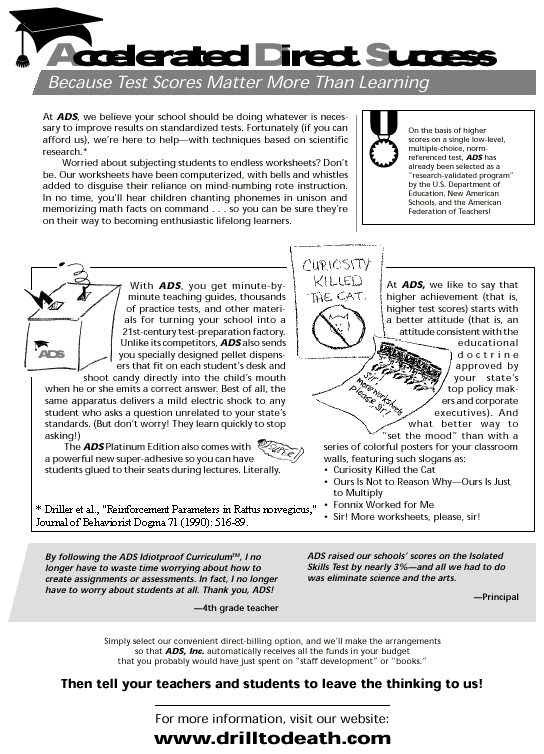
I read Peter Sacks' Standardized Minds a few years ago when I was helping put together our general education assessment process. This led me to look for others attempting to counter the standardization of education, and I found Alfie Kohn [website]. I corresponded with him briefly about some of the issues, and sent him our subjective assessment techniques. On the front page of Reddit today (it's embarassing how much of my news comes from this geeky aggregator) is a parody by Alfie of the standardized testing process. From the fake ad:
With ADS, you get minute-by-minute teaching guides, thousands of practice tests, and other materials for turning your school into a 21st-century test-preparation factory.
The whole thing is pretty cringe-worthy, because like any good parody it's not far from truth. For example, the SAT critical reading section gives the test-taker a chance to show how well she understood what she read. From the College Board's SAT test preparation web page:

There are two types of multiple-choice questions in the critical reading section:

Here, 'critical reading' has been reduced to simple understanding of what you've read. No wonder, since actual critical thinking is such a mess to assess.

So it's easy to take shots at the current methodology of mass production testing, which I refer to sometimes as neo-phrenology, but is it so easy to put your finger on the exact problem? Obviously, we want to know whether or not the students are learning, and so we test them. If the tests and test conditions are all the same, then it's fairer than testing willy-nilly. Two short steps, and we have arrived at industrial testing. So where did we go wrong?

The problem is a nasty little enthymeme.* Instruction and testing, as I experienced it in school, and as my daughter is now, focus primarily on analytic/deductive processes. That is, low-complexity thinking. Let me explain.

Suppose you take a quiz on US state capitals, and you know 49 of them. How hard it is for you to figure out the 50th from your knowledge of the 49? It's clearly impossible--there is no information in the first 49 that contributes to the knowledge of the 50th. In informational terms, the names are random. This just means that you have to know it because it's not figureable out. In other words, you can't get there by generalizing.

Much of education is of this sort. What date was the Pearl Harbor attack? You either know or you don't. It's not like you can go scribble in the corner for a while and come up with the answer through sheer mental effort.

Some problems are solvable from given information, of course. This is largely in the sciences, where some raw materials are given, and the solution to a problem is latent in those materials. Chemical reactions, physics modeling, math word problems, and the like all depend on more advanced forms of deductive reasoning (or analytical thinking if you like). This can become quite sophisticated, such as solving systems of linear differential equations by finding eigenvalues of matrices, and so forth. But this is still not generalizing, it's just applying more complicated methods of analysis--the rules are more dense.

The hidden assumption inherent to standardized testing is that if students are good at analytical/deductive thinking, they will be good at creative/inductive thinking that leads to insightful generalization. That is, that students who test well will be good at generalizing problem solving. This skill is much harder than analytical reasoning, because there is only trial and error, seasoned by experience, as a guide. And yet the ability to solve problems creatively, generalizing from what one already knows, is arguably the most prized kind of thinking; this is where new knowledge comes from.

In science class, students sometimes taught the scientific method by looking at information and forming hypotheses. Literature classes are hard because of the fuzziness inherent in generalized, creative thinking. Same for geometry, where analytical methods are taught as a conduit to creative proof construction. These are valuable experiences because they teach new modes of thought, essentially finding patterns and exploiting them.

It's hard to use a fill-in-the-bubble test to look for generalized thinking because the answers are right in front of you. The whole point of a creative endeavor is that the answer isn't given, and may not even exist! Even free-form elements like writing a short essay are subjected to analytical measures when scoring in a standardized context. How do you teach a computer to measure creativity, after all?

By placing so much importance on standardization, we emphasize rote problem solving and step-by-step methods--the hallmarks of deductive reasoning. This is not unimportant--one does need to know ones times tables--but it's setting the bar too low. Conveniently, it's far easier to assess and teach analytical skills. Unfortunately, it misses the larger point. We need thinkers who can do the following:
  1. Look at what's given and recognize connections because of analytical training
  2. Form ideas about patterns that may exist and test these guesses against what is known
  3. Generate paths of inquiry to find new information that solidifies or overturns existing knowledge
Standardized testing as it is commonly done only addresses the first point. If our students really learn to think, it will not be because of test-preparation.

*I think I may have gotten that line from Giles Goat Boy (another parody of higher ed) by John Barth. Highly recommended.